


from the walls of the digital cave

Hi
How much of reality is shaped by perspective?

Every child begins
as an untethered scientist,
only questions, and with
no great concern for answers,
the magic is in the not knowing

How is it that questions
become less an exaltation
of the not knowing,
and more a threatening
of the answers we don't share

At some pause along the way
from there to here, answers
step past questions in the
hierarchy of concerns, and,
in what may be irony,
less is known
All of it
What Percentage of the Human Brain Is Used?
" You may have heard that humans only use 10 percent of their brain power, and that if you could unlock the rest of your brainpower, you could do so much more. You could become a super genius, or acquire psychic powers like mind reading and telekinesis. However, there is a powerful body of evidence debunking the 10 percent myth. Scientists have consistently shown that humans use their entire brain throughout each day. "
This is one of those things you grow up hearing. The 10% theory of the brain. I certainly believed, without investigation, that we had this untapped potential, the possibility of superhuman cognition. But, from all measured evidence, it seems more likely we use the entire brain. Which I have to say is disheartening and obvious at the same time. There is a hopefulness to the idea that we are on the edge of being more. The reality is they, the measurers of the brain’s activities, haven't found any areas of the brain that are completely inactive, every part appears to function with purpose. On a positive note, for dreamers, there are no instruments to measure the metaphysical, and we don’t really understand how the brain works.
Words have meaning
Gaslighting, Narcissist, and More Psychology Terms You’re Misusing
" Other terms that have crept from the therapist’s couch into the public lexicon include love-bombing, triggered, grooming, and toxic. Frequently, mental-health experts say, when we overuse these words, we also misuse them. ...
While terms like gaslighting have existed in therapeutic practice for decades or longer, most only started to become common lingo within the past few years, fueled by use on social-media platforms. One viral Reddit post or TikTok video is all it takes for the masses to latch onto a previously overlooked word. "
I liked this article because these terms are just thrown around, and it lessens the impact of the intended meaning. Often they are used inaccurately, generating confusion and harm. Sometimes they are accurate in the sense that it gives you a peripheral vision of something, but a vision dipped in hyperbole. They lose their meaning, they lose their power if we just chuck them around higgledy-piggledy for any purpose. Toxic is a good example. He or she is toxic, I hear this being used more and more. No they aren’t, toxicity is a heinous thing. A person extremely threatening to your health and well being is toxic. It’s not meant to describe a jerk, a bad date, or a partner in a soured relationship. I found it a good reminder that some words have powerful meanings worth preserving.
See what you’re doing
Use your imagination to prepare for any task
" The answer matters – it could affect your confidence and, ultimately, how well you go on to perform. Yet, all too often, people don’t take these moments spent in their imagination as seriously as they should. Most people know the importance of physical practice and preparation, but they neglect this other fundamental layer of training. When you are faced with an important challenge, your imagination isn’t just a bystander in the process; it is a tool that directly influences your chances of success. "
To me, this is one of the most powerful techniques there is for finding, and maintaining, success in any endeavour. Visualization is the magic power of the mind. The ability to influence an outcome by visualizing the steps needed and the results desired. I first heard about these techniques as they applied to athletes, incorporating these methods into their training. I don’t think any high level competitor is lacking this tool. Quickly I realized that anybody successful, when asked, was describing some version of this. I wonder if our ability to form complex, intentional, visualizations is what separates us from the other creatures more than anything else. There is overlapping of my internal thoughts and visualizations, but they are not the same thing.
February 4–11, 1945
Yalta Conference
Rearranging the pieces

Wiki Rabbit Hole
" The Yalta Conference, held 4–11 February 1945, was the World War II meeting of the heads of government of the United States, the United Kingdom and the Soviet Union to discuss the postwar reorganization of Germany and Europe. The three states were represented by President Franklin D. Roosevelt, Prime Minister Winston Churchill, and General Secretary Joseph Stalin. The conference was held near Yalta in Crimea, Soviet Union, within the Livadia, Yusupov, and Vorontsov palaces.
The aim of the conference was to shape a postwar peace that represented not only a collective security order, but also a plan to give self-determination to the liberated peoples of Europe. Intended mainly to discuss the re-establishment of the nations of war-torn Europe, within a few years, with the Cold War dividing the continent, the conference became a subject of intense controversy. "
More than shelter
How Igloos Work
" Long before brick or wood houses with indoor heat became commonplace, people had to be creative when building homes to protect them from nature's elements. Wealthy Europeans embraced the concept of a nearly indestructible castle built from stone. Native Americans in warmer climates favored the tepee, or tipi, made entirely of animal hides or bark.
Unfortunately, for the inhabitants of Earth's more frigid regions, such as the Canadian tundra, neither of these were good options. Building materials were pretty much nonexistent, making it difficult to craft even the most rudimentary home. These people used the only abundant material to form a modest roof over their heads: snow. Thus, the igloo, the Inuit word for "snow house," was born. "
Hi Madmantastico, this one is for you. Igloos are awesome. Every kid who grows up in a cold climate has built some version of an igloo on that day when the snow was just perfect for construction. It's an amazing structure, people can live their lives in these snow houses. It's fantastic. You think about the ingenuity and efficiency they developed over time, a process which has remained largely unchanged because it is exactly the solution. This article I particularly like because it also gives you some insight into Inuit traditions and Inuit lifestyle. The Inuit are very much a thriving, growing, community in northern Canada. A uniquely vibrant and different lifestyle, a wonderfully other way of being.
Winter wonderful
Surprising facts about snow
" It’s often stated that the Inuit have 50 words for snow, a fact that was discredited as pure speculation, and then confirmed as roughly accurate. No matter how many they actually have, it pales in comparison to the Scots. Researchers at the University of Glasgow claim that the Scots language has 421 terms related to the white stuff, including ‘skelf’ (a large snowflake), ‘spitters’ (small drops of driving snow) and ‘unbrak' (the beginning of a thaw). "
Apparently this is the February winter issue. Again, as somebody who grew up in Canada, it’s endlessly interesting to consider snow and all the possibilities of living in it, and having fun with it. As well as being respectful of what it represents: a monumental problem if you're not prepared.
While we still believe
Wildlife photo competition
" A badger appearing to admire a Banksy-style graffiti version of itself has won the Natural History Museum's 2024 Wildlife Photographer of the Year People's Choice Award.
Captured on a quiet road in St Leonards-on-Sea, England by British photographer Ian Wood. "
Another collection of amazing nature photographs. More completely than anything else, nature underlines the glory of a beautiful photograph. Some wonderful photos, really cool. I like to include these and look at them because we're rapidly approaching a time when we won't be able to tell what's a genuine photo and what's just something that the robots cobbled together. So I think we should appreciate it while we can. While we can still look at a picture and think, wow, that's real, that actually is.
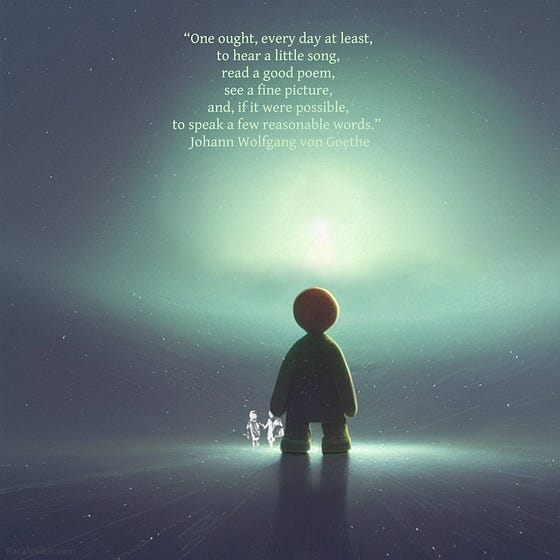
“One ought, every day at least, to hear a little song, read a good poem, see a fine picture, and, if it were possible, to speak a few reasonable words.”
Johann Wolfgang von Goethe
it's your life
you understand
Feel free to share Change Happens with anyone you think might enjoy it, and have a most excellent day


