


from the walls of the digital cave

Hi
Don't we all draw a line in the sand? Don't kill. I'm completely on board, this is a tremendous precept, simple to understand and implement. You would think. A mosquito lands on your arm, you, being full of love and compassion, beg it leave, brush it off to elsewhere, the bug, being of limited directives, returns, endlessly. There is but one ending to this encounter, speed and accuracy the only delay. This counts towards a consideration of a skill set native to us all. The differences would be in where we draw the line.

Your car knows
What Data Does My Car Collect About Me and Where Does It Go?
" There’s probably no other product that can collect as much information about what you do, where you go, what you say, and even how you move your body (“gestures”) than your car. And that’s an opportunity that ever-industrious car-makers aren’t letting go to waste. Buckle up. From your philosophical beliefs to recordings of your voice, your car can collect a whole lotta information about you. "
An article that casts light on the kind of data that is being collected by the various robots. We are constantly hearing about our data being collected, but what exactly does that mean? How is it being collected and for what? It’s a good look at the answers to these questions from the lens of what data your car can and does collect. If you do nothing else, open the article and go through the graphic which shows the data that can be possibly collected. It’s an eye-opening scrolling experience. It’s also kind of horrifying if you believe some things should belong only to you.
Food paint
The Right Chemistry: The colourful history of food dyes
" It wasn’t until the Middle Ages that the first controversy about food colouring cropped up. Bread made from refined white flour came to be favoured over coarse, dark bread because it looked to be more “pure.” White bread was more expensive to produce, so some bakers took the short route and added chalk (calcium carbonate) or lime (calcium oxide) to dark bread to lighten it. This did not go down well with King Edward I (1272-1307) who introduced the first law dealing with food adulteration. 'If any default shall be found in the bread of a baker,' the king decreed, 'let him be put upon the pillory and remain there at least one hour in the day.' "
A consideration of the history of food dyes. Reading about the ban of Red dye № 3 led me to this. It always makes me laugh, a kind of scared and concerned laugh, when these issues arise. Why do we ever eat food with numbered, human built, ingredients? That can’t be right. A quick perusal of the interweb reveals that Red dye № 40 is probably worse, but not yet banned. Etcetera. The use of food dyes goes back a long way, but it’s only relatively recently that the colouring started to be frankensteined up in a lab by us as opposed to obtained from nature. What could possibly go wrong.
From parts unknown
Some Scientists Believe All Life Started on Mars
" This special case of the overall theory of panspermia, where life on Earth began somewhere else and traveled or was planted here, has some prominent supporters. ...
Researchers also study unique qualities that Mars and Earth share compared with the other planets in our solar system, and Mars is, in many ways, a smaller, older Earth that “burned out” its natural resources and electromagnetic core sooner. "
Here we go, a little bit of science, a little bit of science fiction. Some scientists, actual plaque on the wall investigators, believe life started on Mars. The fascination with the possibility of life elsewhere, and the discussion of ‘can we get off this rock and live somewhere else?’, are dinner fuel conversation everywhere. Did life begin somewhere else and travel here, or, even better, if you like to inject some excitement into your speculations, was it planted here? The article actually makes a good case for the possibility of life beginning on Mars, essentially a smaller and older burned out version of Earth. It’s interesting to think about. In the spirit of our fact deficient times: speculate away.
January 24, 1984
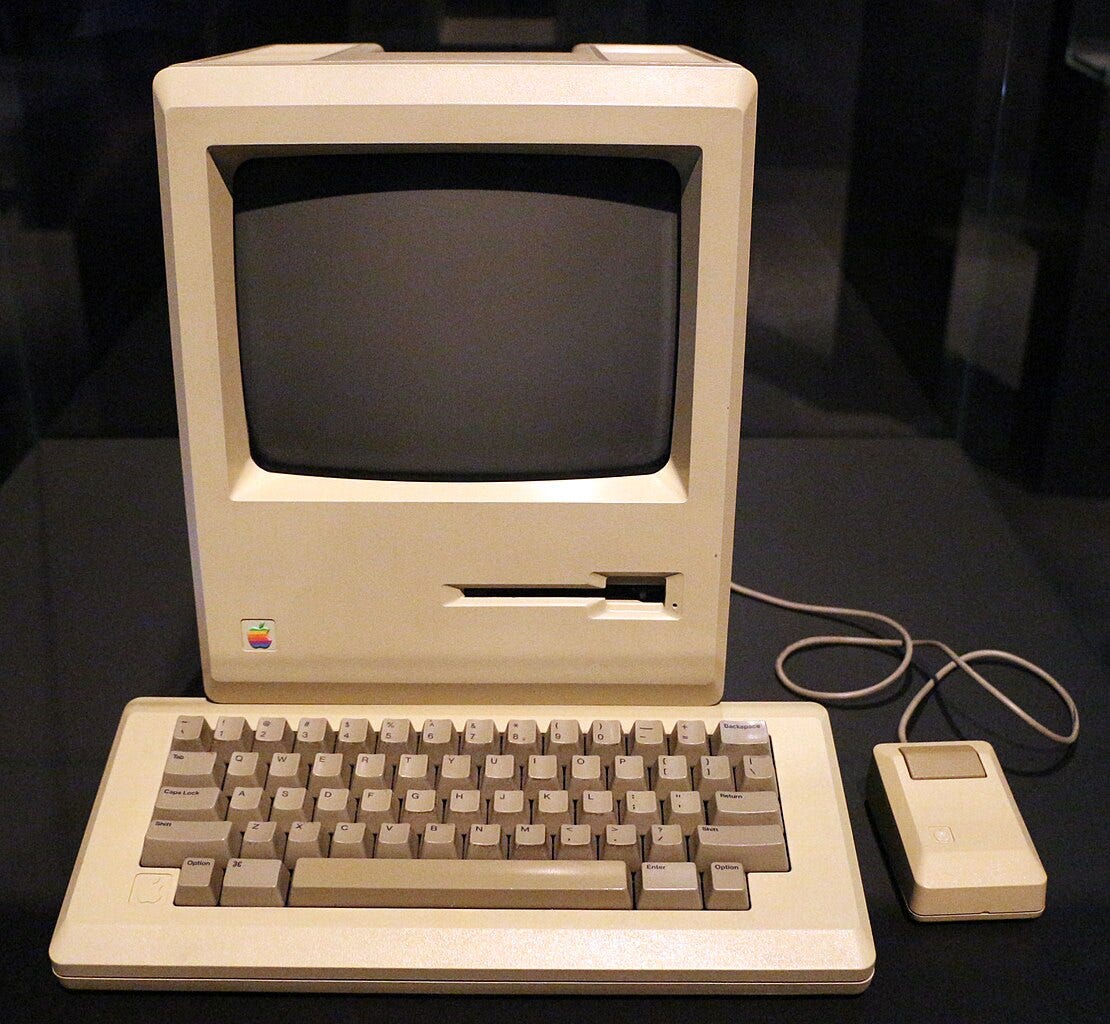
Macintosh 128K
The OG PC
Wiki Rabbit Hole
" The Macintosh, later rebranded as the Macintosh 128K, is the original Macintosh personal computer from Apple. It is the first successful mass-market all-in-one desktop personal computer with a graphical user interface, built-in screen and mouse. It was pivotal in establishing desktop publishing as a general office function. The motherboard, a 9 in (23 cm) CRT monochrome monitor, and a floppy drive are in a beige case with integrated carrying handle; it has a keyboard and single-button mouse.
The Macintosh was introduced by a television commercial titled "1984" during Super Bowl XVIII on January 22, 1984, directed by Ridley Scott. Sales were strong at its initial release on January 24, 1984, at $2,495 (equivalent to $7,300 in 2023), and reached 70,000 units on May 3, 1984. "
Not built to last
Why do we age?
" Aging ranks with sleep as one of the fundamental mysteries of human biology. What causes the body to slow down, its cells to stop dividing, and its organs to fall prey to increasing illness and disability? No one has definitive answers to these questions, but theories can be grouped into two camps: gradual damage over time and genetic programming. "
An article about why we age. Another subject that we still don’t fully understand. Maybe our Martian ancestors knew. The authors simplify it into two camps: We wear out like an old car, no longer able to find parts for what we can’t repair. Or, we are genetically predisposed to a finite timeline that is encoded on a cellular level. Same thing, really; we have a shelf life. It’s interesting that the central nervous system, the brain, the spinal cord, is among the least affected by age. Apparently we are constructed for the critical systems to retire last, which seems in line with a survival imperative. Whether it is an inability to continue repairing breakdowns of the mechanism, or it is that the mechanism itself is only functional for a preprogrammed amount of time, the result is organic decay that we don’t fully understand.
Feeling loss
Why some animals appear to mourn their dead
" In 1972 Jane Goodall, an English primatologist who has studied chimpanzees in the wild for over 60 years, observed one young chimpanzee known as Flint showing signs of what in humans would be called clinical depression when his mother died. He stopped engaging in social interactions with his group, refused to eat, and eventually died a month later.
Even birds grieve, it appears. Austrian zoologist and ethologist Konrad Lorenz once described the response of greylag geese to losing their mate as 'roughly identical with those accompanying human grief'. The geese hung their heads dejectedly, lost interest in food, and became indifferent to the world around them. "
I feel like we are only beginning to realize the richness of the lives of other creatures. Not just as an exercise in anthropomorphization, I see you Winnie the Pooh, but as a real consideration of what they might be experiencing. Specifically, this is an exploration of why some animals appear to mourn their dead. A killer whale was recently spotted off the Washington (US) coast pushing the body of her newborn calf, she had been seen doing the same thing in 2018. Given the enormous amount of energy required for her to keep her child from sinking for days, it’s hard to imagine that anything is in play here but grief. Feeling the loss of a profound connection seems like the very foundation of mourning. Why would other animals not experience this loss?
A natural orchestra
Natural Version of Colombia’s National Anthem
" At dawn on a day in August, biologist Santiago Monroy and producer José Álvarez traversed through the Colombian forests and moors in search of birds. They carried with them parabolic microphones, recorders, cameras and field gear. They traveled more than 600 miles to gather audio. The journey took them from the Eastern Plains to the Chingaza moor, and finally to the Sierra Nevada de Santa Marta. Most days they woke up at 3 a.m. to adjust themselves to nature’s rhythms and record birds’ most active moments. "
A scientist and a composer walked into a bar… It feels like this story had to have its beginnings in the mutual enjoyment of some substance or another. The journey of two people through Colombian forests, recording everything they heard, birds mostly, but all noises of nature about. Then they took all of this and worked it into a version of the Colombian National anthem. There’s a little video in here that plays the song, it’s fun. And kind of awesome that they did this. As a quick aside, in case you find yourself in need of a factoid, Columbia is the most biodiverse country in the world per square kilometer.
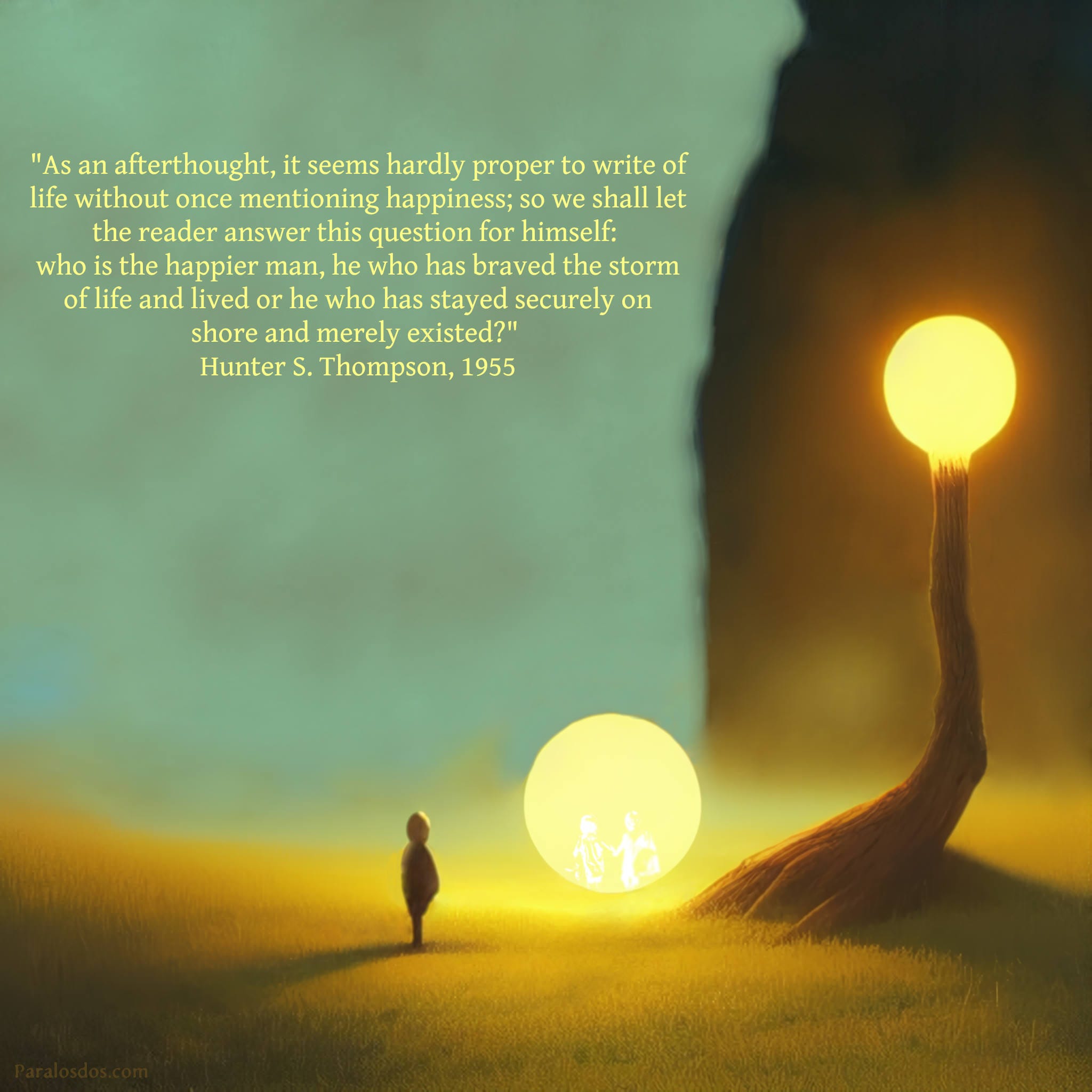
"As an afterthought, it seems hardly proper to write of life without once mentioning happiness; so we shall let the reader answer this question for himself: who is the happier man, he who has braved the storm of life and lived or he who has stayed securely on shore and merely existed?"
Hunter S. Thompson, 1955
it's your life
you understand
Feel free to share Change Happens with anyone you think might enjoy it, and have a most excellent day


